The VA Firewall Method: How to Reach Financial Independence Without Touching Your VA Compensation
A framework some veterans use to separate VA compensation from spending to accelerate debt payoff and wealth building.

IMPORTANT: This article provides educational information only. VetFIRE LLC does not provide investment advice. Consult a licensed financial advisor before making investment decisions.
🔑 Key Takeaways
- Complete separation: Some veterans choose to keep VA compensation separate from their lifestyle budget, directing it toward debt elimination and investing
- Phase 1 Liberation: Some veterans start with a smaller emergency fund, then allocate a significant portion of VA compensation toward debt elimination. Specific amounts and timelines depend on individual circumstances and risk tolerance
- Phase 2 Acceleration: Once debt-free, build full emergency fund and redirect toward long-term savings goals. A 60% rated veteran could build ~$245K in 10 years (7% real return after inflation, static contributions)
- Child Firewall: VA child benefits invested from birth could grow to ~$739K by age 60 (7% real return after inflation)
- The math works: These projections use static 2026 rates. COLA adjustments would increase contributions over time
I used to treat my VA compensation like any other income. It hit my checking account, mixed with my paycheck, and disappeared into bills, groceries, dining out, subscriptions. Every month, gone.
Most veterans do the same thing. There's nothing wrong with it. VA compensation exists to support veterans with service-connected conditions, and using it for living expenses is a completely valid choice.
But one day I got curious: what if I stopped spending it? What if I pretended that money didn't exist for day-to-day life?
That question changed everything for me. I call the answer The VA Firewall Method.
The concept is simple but powerful: create a complete separation between your VA compensation and your lifestyle. Live entirely on household employment income. Consider directing your VA compensation toward debt elimination and wealth building. Some veterans choose to treat VA compensation as if it doesn't exist for spending purposes, directing it instead toward debt payoff and investing.
In this article, I'll break down the framework, show you how it works in practice, and explain why this separation could be the fastest path to financial independence for veterans willing to commit to it.
The VA Firewall Method: Core Principles
Principle 1: Income Separation
Maintain two completely separate income streams in your mind: household employment income and VA compensation. They serve different purposes and should never blend.
Principle 2: Live Below One Income
Reduce your lifestyle expenses to fit entirely within household employment income, excluding VA compensation from budget calculations.
Principle 3: VA = Debt Elimination + Investing Only
Some veterans choose to direct VA compensation toward eliminating debt (Phase 1) then investing (Phase 2). Your consistent monthly VA check can serve as a backstop. Some veterans choose to keep VA compensation separate from lifestyle spending.
Principle 4: Child Benefits Build Child Wealth
Some veterans choose to direct VA child benefit payments toward custodial investment accounts for their children, potentially building wealth from birth.
Principle 5: Automation Enforces Discipline
Set up automatic transfers the day VA compensation arrives so it never sits in your spending account.
Why "Firewall"?
In cybersecurity, a firewall creates a barrier between a trusted network and untrusted traffic. It prevents unauthorized access and keeps systems separate for protection.
I called it a "firewall" because that's exactly what it felt like when I finally did it. My VA compensation became untouchable. Protected. Completely separate from the money I used for daily life. Once I set up that mental barrier, the math started working in my favor instead of against me.
The firewall isn't just a budget category or an intention to save more. It's a complete mental and operational separation of two income streams with fundamentally different purposes.
Note: The scenarios and examples throughout this article are fictional composite cases created for educational purposes. They represent realistic situations and outcomes for veterans implementing the VA Firewall Method, but are not specific real individuals. These hypothetical examples illustrate real financial strategies and their potential long-term impact. While fictional, these scenarios reflect very real patterns. This method represents a genuine strategic approach that, when implemented consistently, can lead to financial independence.
The Two-Phase Framework
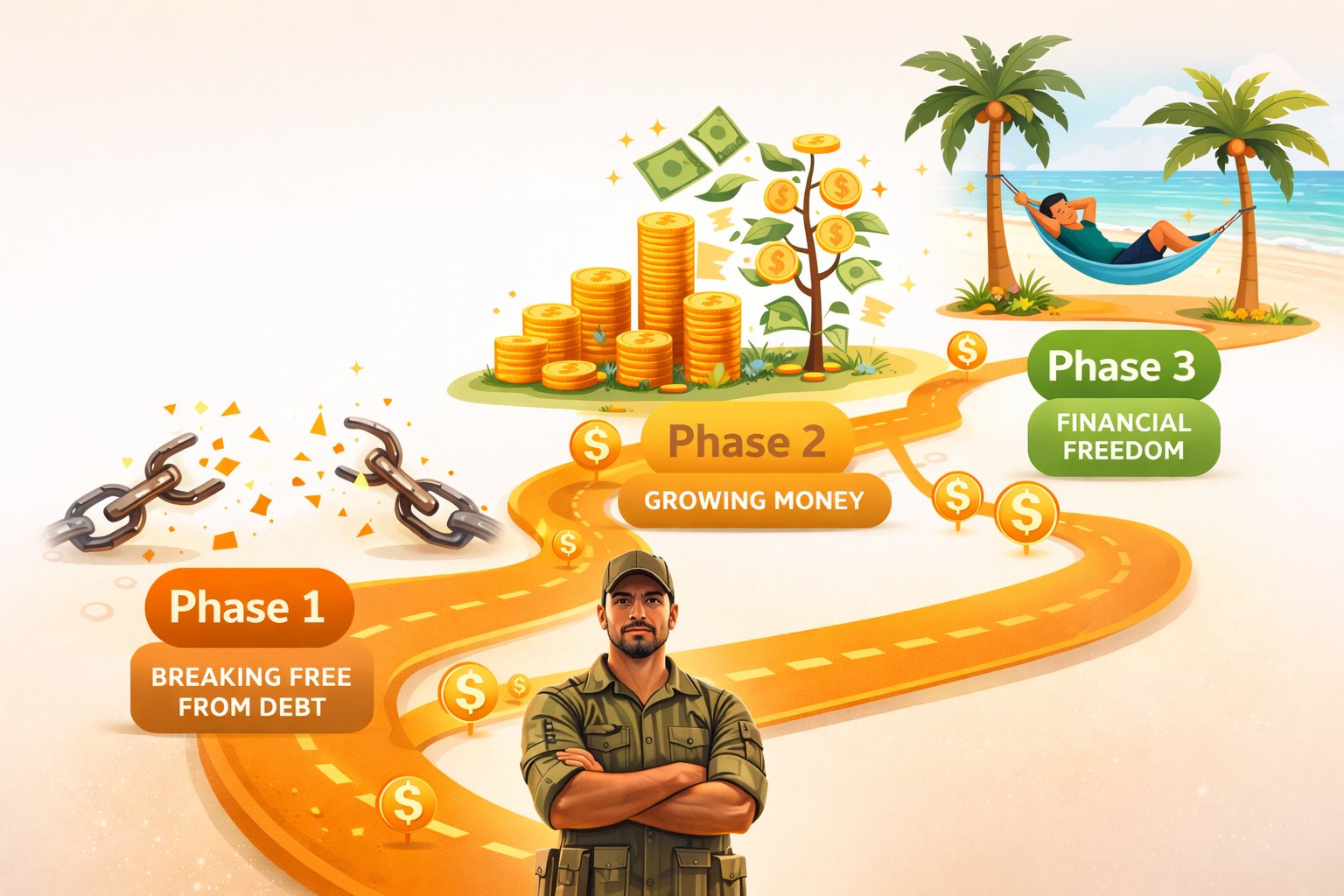
Phase 1: Debt Elimination (The Liberation Phase)
Before wealth can accumulate, many financial educators suggest addressing the obstacles draining your money every month. For most veterans, that means consumer debt.
Why Debt First? Your VA Check IS Your Safety Net
Traditional advice says build a full emergency fund before attacking debt. But here's what those advisors miss: your VA compensation arrives every month like clockwork.
A civilian who loses their job has zero income. You have $1,435/month (at 60%) hitting your account no matter what. That changes everything.
The veteran-specific approach:
- Mini emergency fund first: $1,000-$2,000 in a savings account. Just enough to cover a car repair or medical copay without pulling out the credit card.
- Then consider prioritizing high-interest debt: Some financial educators suggest prioritizing high-interest debt, as the interest cost typically exceeds savings account returns. The appropriate strategy depends on individual circumstances.
- Full emergency fund after debt: Once debt payments are gone, you can build 3-6 months of expenses quickly.
Want to know your exact emergency fund target? Use the VetFIRE Emergency Fund Calculator to find your number based on your specific situation.
Phase 1 Objective: Zero Consumer Debt
Target debts (in order of priority):
- Credit card balances (highest interest first)
- Personal loans
- Car loans
- Student loans (if not pursuing forgiveness programs)
- Any other consumer debt
Note: Mortgage debt is typically handled separately and might not be paid off in Phase 1, depending on interest rate and individual strategy.
How it works:
Every dollar of VA compensation goes toward debt payoff using either the debt avalanche method (highest interest rate first) or debt snowball method (smallest balance first), whichever keeps you more motivated.
Hypothetical example: 60% disability rating
- Monthly VA compensation: $1,435 (2026 rate, no dependents)
- Total consumer debt: $30,000 (credit cards, car loan, personal loan)
- Average interest rate: 12%
Aggressive debt payoff timeline:
- Month 1-21: All $1,435/month toward debt
- Total paid: ~$30,000 (accounting for interest reduction as principal decreases)
- Result: Debt-free in under 2 years
Compare this to minimum payments spread over 8-10 years while paying thousands in interest. The VA Firewall Method can help pay off debt significantly faster.
Phase 1 Victory: When the last debt payment clears, you've eliminated what was likely costing you $500-$1,000+ per month in payments. Your lifestyle now costs less to maintain, and your VA income is still hitting every month. You're ready for Phase 2.
Phase 2: Wealth Acceleration (The Building Phase)
Once debt is eliminated, the exact same amount that was destroying debt now builds wealth. Nothing changes in your monthly cash flow. The money that was going to debt payoff simply redirects toward long-term savings.
Phase 2 Objective: Consider Investing VA Compensation
Common investment account types veterans consider include employer-matched retirement plans (like TSP or 401(k)), Roth IRAs, additional retirement contributions, and taxable brokerage accounts. The appropriate priority and allocation depends on your tax situation, timeline, and goals. Consult a financial advisor to determine the right sequence for your situation.
Hypothetical example: Same 60% rating, post-debt
- Monthly VA compensation: $1,435.02 (2026 rate)
- Annual VA compensation: $17,220
- In this hypothetical example, the veteran's monthly investment might be split across different account types. A financial advisor can help determine appropriate allocation amounts and account selection
10-year projection (assuming 7% average real return after inflation, static contributions):
- Total contributions: $172,200
- Portfolio value: ~$245,000
20-year projection:
- Total contributions: $344,400
- Portfolio value: ~$728,000
Hypothetical calculations for educational purposes only. Uses static monthly contributions at 2026 rates. Assumes 7% average annual real return after inflation (based on S&P 500 historical average, 1926–2025). Returns are not guaranteed and will vary significantly year-to-year. Does NOT include annual COLA increases to VA compensation (historically 2–3%), which would result in higher actual contributions and growth over time. Actual results depend on market performance, investment choices, fees, and timing. Past performance does not guarantee future results.
The Acceleration Effect: Because you're living on employment income alone, that $245,000 or $728,000 isn't your emergency fund or your "eventually I can retire" fund. It's pure surplus wealth that exists on top of your ongoing VA compensation, dramatically reducing how much you need to achieve financial independence.
Phase 3: Financial Independence (The Freedom Phase)
Phase 3 isn't something you do. It's something you achieve. It's the point where your investment portfolio plus VA compensation can sustain your lifestyle indefinitely, giving you the choice to continue working or retire.
Phase 3 Milestone: Choice Point
You've reached financial independence when:
- Your VA compensation + 4% of your portfolio ≥ your annual expenses
- You have zero consumer debt
- Your lifestyle is sustainable on this combined income
At this point, continued employment becomes optional. You can work because you want to, not because you have to.
Hypothetical example: Reaching VetFIRE™
Veteran with 60% rating after 15 years of Phase 2 investing (static contributions at 2026 rates):
- Annual VA compensation: $17,220 (tax-exempt under current law, 2026 rate)
- Portfolio value: ~$446,000 (hypothetical, based on 7% avg real return after inflation)
- 4% safe withdrawal: $17,858/year
- Combined annual income: $35,078
- Annual expenses: $32,000 (remember, no debt payments, lifestyle adjusted to employment income only)
- Result: Financially independent
Note: This example uses static 2026 VA rates. With historical COLA adjustments of 2-3% annually, actual VA compensation and contributions would be higher over 15 years, potentially resulting in a larger portfolio.
This veteran can retire in their early-to-mid 40s (depending on when they started) without being a millionaire, without owning businesses, without side hustles. Just by firewalling VA compensation for debt elimination and investing.
The Child Benefits Component
If you receive VA child benefits, the Firewall Method extends to create generational wealth for your children.
Child Firewall Principle: Some veterans choose to allocate child benefits toward custodial investment accounts (such as UTMA or UGMA). A financial advisor can help determine whether this approach is appropriate for your family.
Why This Matters
VA child benefit rates (2026, effective December 1, 2025):
- 30% disability: $44.35/month per child
- 50% disability: $73.05/month per child
- 70% disability: $102.41/month per child
- 100% disability: $147.21/month per child
Hypothetical scenario: 70% rating, one child
- Monthly child benefit: $102.41 (2026 rate)
- Invested from birth to age 18: Total contributions = $22,120
- Value at age 18 (7% avg real return after inflation): ~$43,100
- If untouched until age 60 (42 more years of growth): ~$739,000
Uses static 2026 child benefit rate. With historical COLA adjustments, contributions would increase annually. Try the VetFIRE™ Junior Calculator with your actual numbers.
Your child could retire comfortably at 60 because you firewalled their VA benefit into investments instead of using it for current expenses. You're not just building your own financial independence. You're building theirs too.
I don't have kids of my own, but I started accounts for my nephews. Not a lot, but it will grow. The principle works whether it's your children, nieces, nephews, or any young person you want to set up for success.
Important Consideration: Custodial accounts become the child's property at age of majority (18-21 depending on state). Consider teaching financial literacy alongside building wealth so they understand the responsibility that comes with this gift.
The Lifestyle Adjustment Challenge
Here's the hard part, and I'm not going to sugarcoat it: most veterans already use their VA compensation for living expenses. I did too. Implementing the Firewall Method meant I had to reduce my lifestyle to fit within my paycheck alone.
For some veterans, this is relatively easy. Their employment income already covers expenses comfortably. For others, it requires real sacrifice. I was somewhere in between.
Common Adjustments
Housing:
- Some veterans move to a lower cost-of-living area
- Others downsize from a house to an apartment temporarily
- Taking on a roommate or renting out a spare room
- Moving in with family temporarily during a debt payoff phase
Transportation:
- Selling a financed vehicle and switching to a reliable used car purchased with cash
- Becoming a one-car household temporarily
- Using public transportation or biking for commuting
Discretionary Spending:
- Reducing or eliminating dining out
- Cutting subscription services (streaming, gym, etc.)
- Pausing expensive hobbies temporarily
- Shopping secondhand for clothing and household items
The Timeline Matters:
These adjustments aren't forever. Phase 1 might take 1-3 years depending on debt levels. During Phase 2, as employment income grows through promotions or career changes, lifestyle can expand. You're just maintaining the firewall that keeps VA compensation flowing to investments.
Reframe the Sacrifice: You're not giving up quality of life permanently. You're trading 2-3 years of aggressive debt payoff for potentially 20-30 years of early retirement. The math heavily favors short-term sacrifice for long-term freedom.
Real-World Implementation
The Firewall Method requires operational precision to work. Here's how to actually implement it:
Step 1: Separate Bank Accounts
Here's what worked for me: I opened accounts at a completely different bank than my primary checking. Out of sight, out of mind.
- One account for debt payoff (Phase 1) or brokerage transfers (Phase 2)
- One custodial investment account per child
My VA compensation direct deposits into those separate accounts, never touching my spending account. I literally don't see the money unless I go looking for it.
Step 2: Automate Everything
Phase 1 automation:
- VA comp arrives → automatically transfers to debt payoff account
- Automatic payments from that account to creditors on the same day each month
- Child benefits → automatic transfer to custodial accounts (consult a financial advisor regarding investment strategies)
Phase 2 automation:
- VA comp arrives → could be split between retirement accounts and/or brokerage (work with a financial advisor to determine appropriate allocations)
- Many advisors recommend dollar-cost averaging strategies
- Child benefits continue automatic contributions to custodial accounts
Step 3: Remove Temptation
Financial advisors often recommend not keeping debit cards for dedicated savings accounts and avoiding linking them to payment apps. The goal is making it more difficult to access this money for anything other than its designated purpose.
Step 4: Track Progress Visibly
Create a simple tracking system:
- Phase 1: Debt payoff thermometer showing progress to $0
- Phase 2: Investment growth chart updated monthly
- Child accounts: Quarterly check of projected value at age 60
Visible progress reinforces discipline when temptation strikes to "just use a little" of the VA comp for something else.
📬 Join the VetFIRE Community
Get calculator updates, new blog posts, and hear how other veterans are thinking about financial independence. No spam, just real talk.
No spam. You must be 18 or older to subscribe. Unsubscribe anytime. We respect your privacy.
When the Firewall Method Works Best
This framework isn't for everyone. It works best in these situations:
- You have significant consumer debt: The faster you eliminate it, the more the method accelerates wealth building
- You have stable employment income: Living on one income requires that income to be reliable
- You're willing to sacrifice short-term comfort: The lifestyle reduction is real, especially initially
- You have a long time horizon: The longer you maintain the firewall, the more powerful compound growth becomes
- You have discipline or can automate it: The method fails if you constantly break the firewall for "emergencies"
- Your VA rating is stable: Works best when you can count on compensation continuing
When to Modify or Skip This Method
The Firewall Method might not be appropriate if:
- Your disability significantly limits employment income potential
- You have high medical expenses not covered by VA healthcare
- You're a single parent with limited family support
- Your employment income barely covers basic necessities
- You have dependents with special needs requiring substantial resources
- Your mental health would suffer from the stress of extreme frugality
Financial strategies should support your wellbeing, not destroy it. If the Firewall Method would cause significant harm to your mental health, family relationships, or quality of life, a less aggressive approach might be more sustainable.
Variations on the Firewall
The 100% firewall is the pure version, but modifications can work for different situations:
The 80/20 Firewall
80% of VA compensation to debt/investing, 20% supplements lifestyle. Slower but less restrictive.
The Gradual Firewall
Start with 50% firewalled, increase 10% every 6 months as you adjust to reduced lifestyle. Reaches 100% over time.
The Phase-Focused Firewall
100% firewall during debt payoff phase, then reassess for investment phase. Some people maintain 100%, others drop to 70-80% after debt freedom.
The key is intentionality: whatever percentage you choose, that portion of VA compensation never accidentally drifts into lifestyle spending.
Measuring Success
How do you know the Firewall Method is working?
Phase 1 Metrics:
- Debt balance decreasing monthly by the full VA compensation amount
- Projected debt-free date getting closer
- Interest paid decreasing each month
- Zero VA compensation dollars spent on lifestyle
Phase 2 Metrics:
- Investment contributions exactly match VA compensation
- Portfolio balance growing consistently
- Child custodial accounts growing automatically
- Lifestyle remaining stable on employment income only
- FI number (financial independence target) getting closer monthly
Phase 3 Indicator:
- The moment when (VA comp + 4% of portfolio) ≥ annual expenses
- You've achieved VetFIRE™
The Mindset Shift
The Firewall Method requires a fundamental shift in how you view VA compensation.
Old mindset: "I receive $X from VA and $Y from work, so I can spend up to $X + $Y."
Firewall mindset: "I can spend up to $Y from work. The $X from VA doesn't exist for spending. It exists for building future freedom."
This shift is psychological before it's practical. The money is yours. You could spend it. The government isn't going to stop you. The discipline is entirely self-imposed.
But that's also the power: you're choosing to separate one income stream specifically to build wealth, knowing that the reliable nature of VA compensation means this wealth compounds on top of income you'll receive for life.
Common Obstacles and Solutions
Obstacle: "I can't reduce my lifestyle enough"
Solution: Start with 50-70% firewall while you make bigger changes (housing, vehicle). Increase percentage as changes take effect. Perfect is the enemy of good.
Obstacle: "What about emergencies?"
Solution: Build a small emergency fund ($1,000-2,000) from employment income first, then start the firewall. True emergencies are rare; most "emergencies" are predictable expenses poor planning.
Obstacle: "My spouse isn't on board"
Solution: Show them the math. Project debt-free date. Project 10-year investment balance. Project early retirement age. Numbers often convince where words don't. Consider marriage counseling if financial disagreement persists.
Obstacle: "I keep breaking the firewall"
Solution: Increase automation. Remove access to accounts. Partner with accountability person. If repeated failure, acknowledge this method may not fit your personality and try a less restrictive approach.
Obstacle: "Interest rates are low, why rush debt payoff?"
Solution: It's not just about interest rates. It's about cash flow liberation. Eliminating $800/month in debt payments means needing $9,600 less per year to live, which means needing $240,000 less invested to retire. The freedom value exceeds the math.
The Generational Impact
One of the most powerful aspects of the Firewall Method is what you're teaching your children by example:
- They see income discipline. Not all money that arrives gets spent
- They learn about investing. Their custodial accounts grow visibly over time
- They understand delayed gratification. Short-term sacrifice for long-term benefit
- They inherit financial literacy. These lessons shape their own money habits
- They start adulthood with assets. While peers have debt, they have investment accounts
You're not just building your financial independence. You're potentially breaking generational poverty cycles and creating a family culture of wealth building.
Is the Firewall Method Right for You?
Only you can answer this, but here are questions to consider:
- Could your household survive on employment income alone if you had to?
- Are you willing to make temporary sacrifices for long-term freedom?
- Do you have consumer debt that's preventing wealth building?
- Can you maintain discipline over multiple years, or automate it sufficiently?
- Does your VA rating seem stable enough to count on?
- Would financial independence in 10-15 years be worth significant sacrifice now?
- Are you starting early enough that compound growth has time to work?
If you answered "yes" to most of these, the Firewall Method might accelerate your path to VetFIRE™ significantly.
If you answered "no" to several, a modified approach or different strategy might be more appropriate.

The Bottom Line
The VA Firewall Method is simple in concept but demanding in execution:
Consider separating VA compensation from lifestyle spending. Some veterans direct it toward debt elimination, then investing, maintaining the separation for years to potentially reach financial independence faster than traditional paths.
It's not easy. It requires sacrifice, discipline, and commitment. I know because I'm living it. But for veterans willing to commit, the Firewall Method offers a clear, structured path from wherever you are financially to complete financial independence. Without requiring high income, business ownership, or side hustle exhaustion.
Your VA compensation is reliable, tax-exempt under current law, and lifetime. The Firewall Method explores how it could contribute to your future goals: not just supporting your current life, but potentially building your future freedom.
I wish someone had shown me this framework years ago. I hope it helps you see what's possible.
- Garcia
Frequently Asked Questions
Model Your VA Firewall Approach
Use our calculator to see how firewalling your VA compensation could accelerate your path to financial independence
Try the CalculatorKeep Reading
Note About VA Disability Rates:
For readability, VA disability compensation rates in this article are rounded to the nearest dollar. Official 2026 rates (effective December 1, 2025) are: 60% = $1,435.02/month, 70% = $1,808.45/month, 100% = $3,938.58/month. For exact rates at all disability levels, please visit VA.gov's official compensation rates page (opens in new tab).